
What does the University of Connecticut mascot Jonathan the Husky, Katy Perry during the 2015 Super Bowl, Star Wars’ C-P3O and the Macy’s Thanksgiving Day parade all have in common?
All are either puppets, or use puppets in their performance.
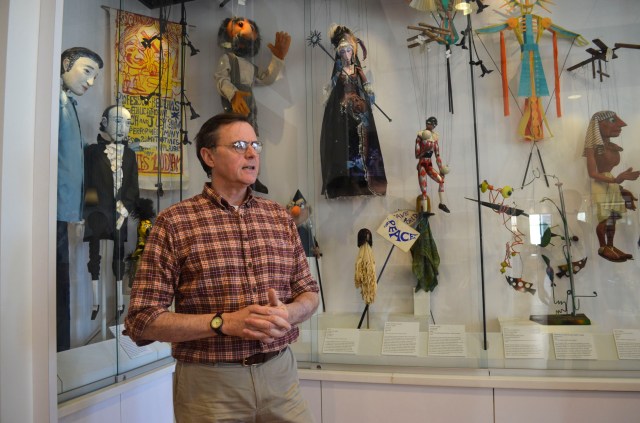
Few people realize this, which is why John Bell, director of The Ballard Institute of Museum and Puppetry and a self-proclaimed “evangelical” puppet fanatic hopes to shed light on the mystery that is puppetry.
Bell first became interested in theater as a high school student. As an English major at Middlebury College in Vt., he saw that jobs in the theater world were kept separate from each other.
“If you’re an actor, you’re not a set designer or a costume designer. These jobs, for important reasons, are kept separate. They’re different trades.”
Bell’s focus changed when he saw the Bread and Puppet Theater in Glover, Vt.
“All of those art forms came together. As a puppeteer, you’re acting, singing, dancing. But you’re also building puppets, you’re writing scripts, you’re schlepping stuff around. Puppetry has always been interdisciplinary. That appealed to me a lot.”
The Bread and Puppet Theater also had a different approach to political theater in the early 1960s.
“In my theater classes I was told that maybe in 30 or 40 years there would be an artistic approach to what’s happening right now in Vietnam, but that you need distance and time for reflection. They said it’s not worthwhile to make art about what’s currently going on.”
Bell admired that the Bread and Puppet Theater were “out on the streets” during the beginning of the antiwar demonstration, using puppets to talk about what’s going on all around us.
“Puppetry is connected to ritual, religion, politics and sex. All of these things come together in puppetry.”
After graduating from Middlebury in 1973, Bell continued to study graduate theater history with a specific emphasis on puppetry at Colombia University. His dissertation was avant-garde early 20th century performance with puppets in Europe.
Bell began working at the Bread and Puppet Theater in 1973 after graduating. He worked as a company member there from 1975-1985.
At the Bread and Puppet Theater, Bell performed, built puppets, played music, made costumes, wrote scripts and built sets.
As museum director, his duties range from changing light bulbs to trying to figure out the scholarly future of puppetry. Bell said the same variety carried over from the Bread and Puppet Theater and that the job doesn’t get boring.
He has also taught at colleges such as New York University, Rhode Island School of Design and Emerson College.
Nestled in the Asian section of “The World of Puppetry,” exhibit sits a foot-high proud soldier atop his black horse. It is a Vietnamese water puppet, Bell’s favorite puppet at the moment.
In 20th century Vietnam, puppeteers used water as their stage. While standing in shallow pools disguised by mesh screens, puppeteers used long underwater rods to tell epic stories with floating puppets.
Bell explained that Vietnam is influenced by Chinese culture and Hindu culture. The Vietnamese have a particular form and technic of puppetry.
He said that if someone wants to know about puppetry, they also need to know about the cultures and society behind them, such as Persian, Vietnamese, or Chinese.
The museum has a collection of 3,000 puppets, the large majority of them being stored at the UConn Depot Campus in Storrs.
The majority of the museum’s puppets are 20th century American. Some of the forms of puppets include shadow, hand, rod, marionettes and full-body puppets.
In addition to being a puppet historian, Bell is also one of the four professors that teach in the puppetry department.
UConn is the only school in the country where one can earn a Bachelors of Arts, Masters of Arts and a Masters of Fine Arts in puppetry.
The museum offers a monthly performance series, two rotating exhibits, a library of books about puppetry, two computer terminals for watching performances and a theater they share with the UConn Co-Op Bookstore, to which they are adjacent to.
Their main mission is to promote public recognition of puppetry as an art form.
“I want to help people think about how object or material performance is part of our everyday lives,” Bell said.
As an example, he cited the Katy Perry Super Bowl performance, in which she glided in on a larger than life boxy gold metallic lion rod puppet.
“I think of puppetry as being both ubiquitous and invisible,” Bell said.
 Claire Tremont's Writing