The Zika virus, an international public health emergency as declared by World Health Organization, has spread as far north as Mexico by active transmission. The virus could potentially reach into the southern United States, specifically Florida and Texas.
There were 273 travel associated cases reported in the United States. As of March 23, more than half the states in the U.S. have reported travel associated cases, according to the Centers for Disease Control and Production.
The Virus is new to the Western Hemisphere, but has been circulating in Asia and Africa for more than 50 years. The first Western cases were reported in Brazil.
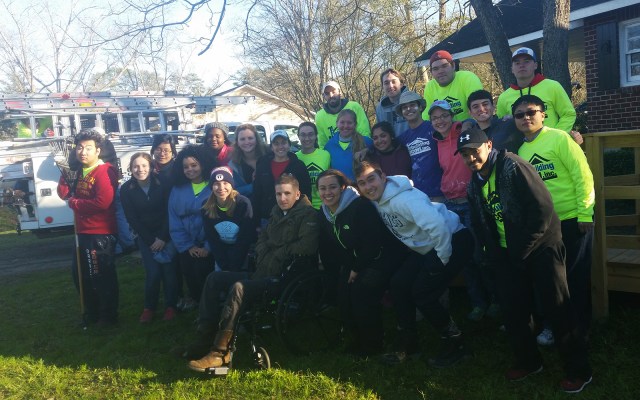
Business Connections Learning Community Traveled to Macon, Georgia to renovate homes for those less fortunate. Photo Courtesy of Chris Colgan.
BCLC Students Repair Homes in Georgia for Those Less Fortunate
Nineteen students from the Business Connections Learning Community (BCLC) gave up a portion of their winter break to clean and paint houses, build wheelchair ramps and tidy up the yards of people in need in Macon, Georgia.
The three-day service trip is part of an annual School of Business pilgrimage to aid low-income, elderly and disabled people.
UConn students said they returned from three days of hard work with a sense of accomplishment and stronger bonds with their classmates.
“We saw states of decay that you normally don’t see around Connecticut,” said Carter Janssen ’18, one of the trip leaders. “A lot of people were put in situations that they might be embarrassed by, which is understandable. Some of them weren’t so eager to come out and say hi to us. But we know they all appreciated the help all the same.”
Chris Colgan ’18, another trip organizer, said that one woman who received a wheelchair ramp looked so happy that there were people who cared about her.
“She was reserved and shy,” Colgan said. “It seemed like she was sad that it had to happen, but grateful at the same time.”
Macon is a financially divided city. While some live in luxury, many others live in inadequate houses, Janssen said. The BCLC students worked under the guidance of Rebuilding Macon, a nonprofit organization that last year renovated 250 homes in the city. They were on the work site from Jan. 11-13.
“One of the best parts of the trip was becoming closer to the people in our group,” Colgan said. “There were some people in the BCLC on my floor that I hadn’t even talked to, but this trip changed that.”
The BCLC funds their trip through student payments. Each student gave $250, which covered gas, food and the three rental vans. The UConn students were paired with a group from the University of Illinois both onsite and overnight at the churches where they were invited to stay.
Janssen and Colgan recruited students for the trip, contacted churches to make sleeping arrangements, lined up the rental car, budgeted the trip, and performed many other duties. They, in turn, praised Rebuilding Macon Executive Director Debra Rollins with helping make the trip a success.
Colgan said that one student who was hesitant about the trip, said afterward, “This trip was so much more than I expected it to be. I’m endlessly glad I came.”
Jess Nieves ’19 and Hayley Lapadula ’18 stressed how friendly the entire group was and how much they bonded.
“I honestly didn’t anticipate how much fun it would be,” said Nieves, adding that taking herself out of her ‘comfort zone’ was a good experience.
The University of Connecticut Rescue Club will soon offer CPR classes for those interested in becoming certified as part of their EMT interests.
UConn Rescue allows certified EMTs to use their skills to gain experience in the medical field. Some members have EMT certification, while others are merely interested in emergency services.
“We look forward to providing the community with life-saving skills,” Megan Rotondo, the club secretary and a fourth-semester pre-med student majoring in physiology and neurobiology said.
Voices of Freedom perform at the Black Girls Rock Event. Photo by Rebecca Newman.
I recently got back into the Life section of The Daily Campus. My first event I chose to cover was a “Black Girls Rock” program, hosted by the National Council of Negro Women. It was a moving event, and I’m excited to be writing for both sections of the paper.
Every chair in Rome Commons was filled during the Black Girls Rock program on March 3. The group honored the contributions of female African American undergraduates, graduate students and faculty to the University of Connecticut community.
The UConn National Council of Negro Women hosted the event. Groups such as the African American Cultural Center, the African American Alumni Council, Omega Psi Phi Fraternity, Phi Beta Sigma Fraternity, Zeta Phi Beta Sorority, Sigma Gamma Rho Sorority, Sisters Inspiring Sisters and National Council of Negro Woman-Hartford Section were represented. More chairs had to be brought into the back of the room for the extra attendants.
The night opened with a poem titled, “To Be a Black Woman and Alive,” performed by Bree’ana Johnson and Geofanne Anderson. The poem touched on how black men turn their noses up at black woman, and how resilient and defiant black women are, simply by existing.
Johnson said that she was inspired by the Black Entertainment Television program, “Black Girls Rock,” and was determined to start a similar program at UConn.
“The turnout and the amount of melanin in the room is wonderful. It’s great to be able to get acknowledgement for the accomplishments that the campus hasn’t been privy too,” Schneider Jean-Baptiste, 8th-semester business administration major, said.
The event included performances by Voices of Freedom, Nubian Foxes and Alyssa Hughes. A capella group Voices of Freedom sang, “Hallelujah, Salvation & Glory,” which filled the room with wonderful mixing harmonies. Hughes performed a slam poem, then she sang about police brutality accompanied by a bongo and guitar player. Dance group Nubian Foxes also contributed by dancing a lively African and Caribbean dance.
The keynote speaker was Jamilah Lemieux, editor of EBONY Magazine. Lemieux frequently appears on Huffington Post, MSNBC and Al Jazeera America.
Lemieux addressed various issues, such as the recent controversial trailer for the Nina Simone movie and the lack of equal female representation in the new “Ghostbusters” movie. In the films, Zoe Saldana plays Simone in blackface, and the one black female ghostbuster works in the New York City metro, while the three white members of the team are scientists.
Lemieux also repeated the belief that, black men, and white men and women, owe something in their lives to a black woman. She stressed the importance of inclusion, including black transwomen, black disabled women and black gay women, among other groups.
Over a brief dinner intermission, groups mingled and watched a Black Girls Rock video made by Troy Brice featuring black UConn female students expressing why they rock, and black UConn male students supporting the women in their lives.
“It’s great to have the support to celebrate ourselves and who we are,” Justin Walters, a sixth semester electrical engineering student said. “Whether you’re black, white, Puerto Rican, any race, it’s important to celebrate where you come from.”
The program awarded Legends, Game-changers and Rockstars awards to faculty members, graduates and undergraduates. The qualified nominees and winners were awarded for their work in academics, volunteerism and activism.
Lemieux and all the speakers shared positive and negative moments. Giggles, tears, hugs and snickers were shared through the night.
“It’s a privilege to be here,” said Isaiah Mohammed, eighth semester management information systems major. “We’re here to make a difference, especially minorities. UConn invested in the right individuals.”
Fred Carstensen professor of finance and economics, will speak at the annual Energy, Environment and Economic Development conference on March 9 from 7 AM to 1:30 PM.
The conference brings together Connecticut leaders from energy and related industries to understand how their businesses interact with environmental policy and development.
Carstensen will give an overview of Connecticut’s economic outlook. He is also the director of the Connecticut Center for Economic Analysis.
Ph.D. Student Speaker Series Continues with Marketing
UCLA Marketing Professor Suzanne Shu discussed retirement savings, and how individuals make their decisions about how much to save and how much to spend, during a presentation to faculty and doctoral students on Jan. 29.
“Risk, Ownership and Loss in Decumulation During Retirement,” was the topic of her speech, presented as part of the School of Business Ph.D. Student Speaker Series, which was attended by faculty and doctoral students.
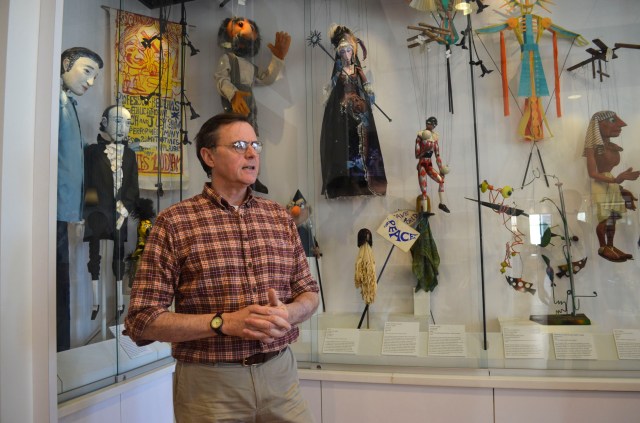
Museum Director John Bell leads a tour through the Ballard Institute and Museum of Puppetry in Storrs, Conn on Feb. 2. The Institute and Museum is home to almost 3,000 unique puppets, Bell said.
What does the University of Connecticut mascot Jonathan the Husky, Katy Perry during the 2015 Super Bowl, Star Wars’ C-P3O and the Macy’s Thanksgiving Day parade all have in common?
All are either puppets, or use puppets in their performance.
Few people realize this, which is why John Bell, director of The Ballard Institute of Museum and Puppetry and a self-proclaimed “evangelical” puppet fanatic hopes to shed light on the mystery that is puppetry.
Bell first became interested in theater as a high school student. As an English major at Middlebury College in Vt., he saw that jobs in the theater world were kept separate from each other.
“If you’re an actor, you’re not a set designer or a costume designer. These jobs, for important reasons, are kept separate. They’re different trades.”
Bell’s focus changed when he saw the Bread and Puppet Theater in Glover, Vt.
“All of those art forms came together. As a puppeteer, you’re acting, singing, dancing. But you’re also building puppets, you’re writing scripts, you’re schlepping stuff around. Puppetry has always been interdisciplinary. That appealed to me a lot.”
The Bread and Puppet Theater also had a different approach to political theater in the early 1960s.
“In my theater classes I was told that maybe in 30 or 40 years there would be an artistic approach to what’s happening right now in Vietnam, but that you need distance and time for reflection. They said it’s not worthwhile to make art about what’s currently going on.”
Bell admired that the Bread and Puppet Theater were “out on the streets” during the beginning of the antiwar demonstration, using puppets to talk about what’s going on all around us.
“Puppetry is connected to ritual, religion, politics and sex. All of these things come together in puppetry.”
After graduating from Middlebury in 1973, Bell continued to study graduate theater history with a specific emphasis on puppetry at Colombia University. His dissertation was avant-garde early 20th century performance with puppets in Europe.
Bell began working at the Bread and Puppet Theater in 1973 after graduating. He worked as a company member there from 1975-1985.
At the Bread and Puppet Theater, Bell performed, built puppets, played music, made costumes, wrote scripts and built sets.
As museum director, his duties range from changing light bulbs to trying to figure out the scholarly future of puppetry. Bell said the same variety carried over from the Bread and Puppet Theater and that the job doesn’t get boring.
He has also taught at colleges such as New York University, Rhode Island School of Design and Emerson College.
Nestled in the Asian section of “The World of Puppetry,” exhibit sits a foot-high proud soldier atop his black horse. It is a Vietnamese water puppet, Bell’s favorite puppet at the moment.
In 20th century Vietnam, puppeteers used water as their stage. While standing in shallow pools disguised by mesh screens, puppeteers used long underwater rods to tell epic stories with floating puppets.
Bell explained that Vietnam is influenced by Chinese culture and Hindu culture. The Vietnamese have a particular form and technic of puppetry.
He said that if someone wants to know about puppetry, they also need to know about the cultures and society behind them, such as Persian, Vietnamese, or Chinese.
The museum has a collection of 3,000 puppets, the large majority of them being stored at the UConn Depot Campus in Storrs.
The majority of the museum’s puppets are 20th century American. Some of the forms of puppets include shadow, hand, rod, marionettes and full-body puppets.
In addition to being a puppet historian, Bell is also one of the four professors that teach in the puppetry department.
UConn is the only school in the country where one can earn a Bachelors of Arts, Masters of Arts and a Masters of Fine Arts in puppetry.
The museum offers a monthly performance series, two rotating exhibits, a library of books about puppetry, two computer terminals for watching performances and a theater they share with the UConn Co-Op Bookstore, to which they are adjacent to.
Their main mission is to promote public recognition of puppetry as an art form.
“I want to help people think about how object or material performance is part of our everyday lives,” Bell said.
As an example, he cited the Katy Perry Super Bowl performance, in which she glided in on a larger than life boxy gold metallic lion rod puppet.
“I think of puppetry as being both ubiquitous and invisible,” Bell said.



 Claire Tremont's Writing